Solar Seeds · Space systems concept
A spacecraft that launches as a seed.
I designed Solar Seeds around two resources: sunlight and water. Each spacecraft launches folded, opens in orbit and joins a network designed to grow and refuel.
Scroll to bloom
Venture concept · live 3D playback
From the notebook · KN-002 · 80 sheets
Solar Seeds, as drawn in the notebook.
Follow the complete study: the vehicle, ARBOR, orbital networks and the proposed programme. Each notebook sheet opens as a live 3D drawing.
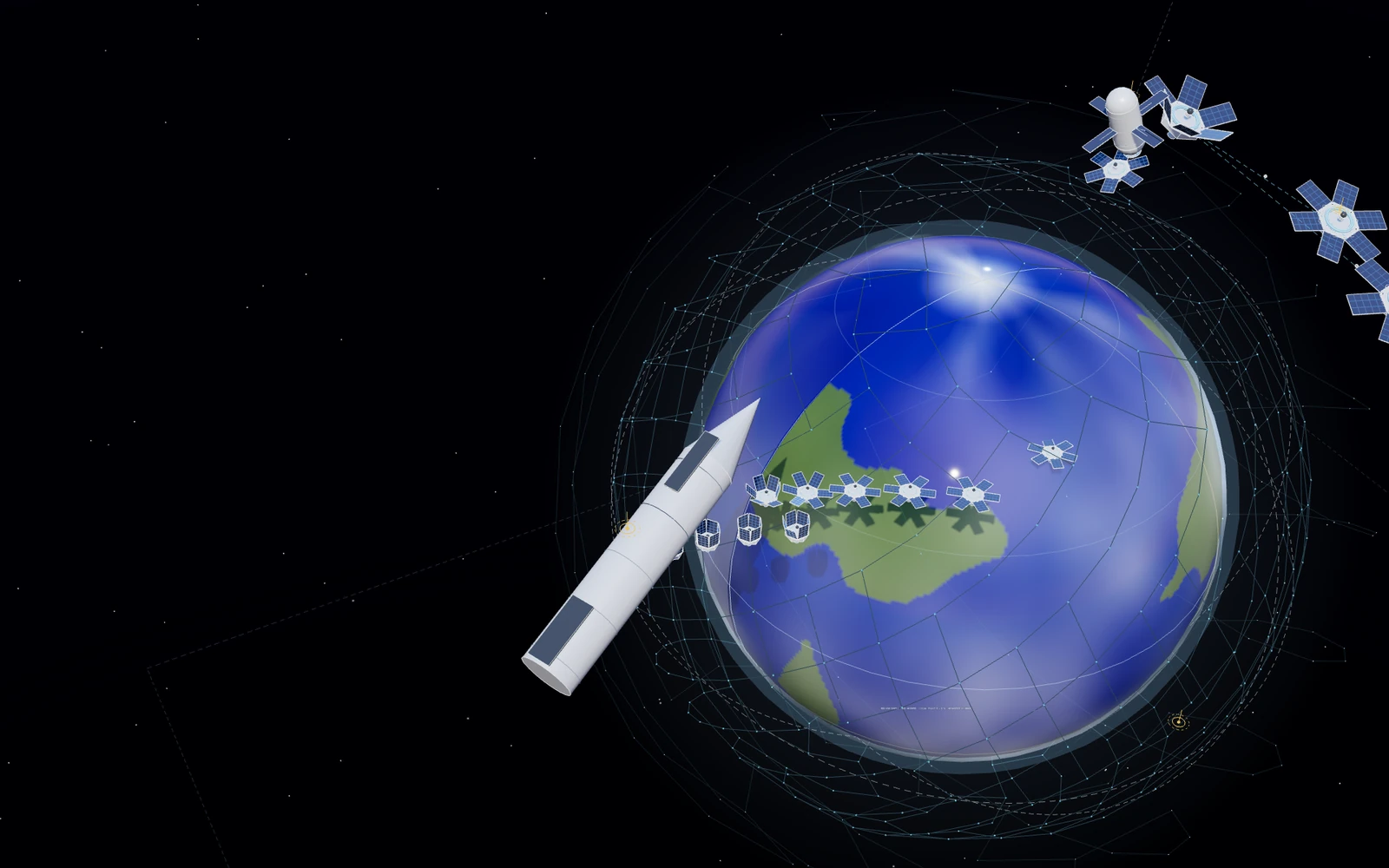 Plate 1 / 12
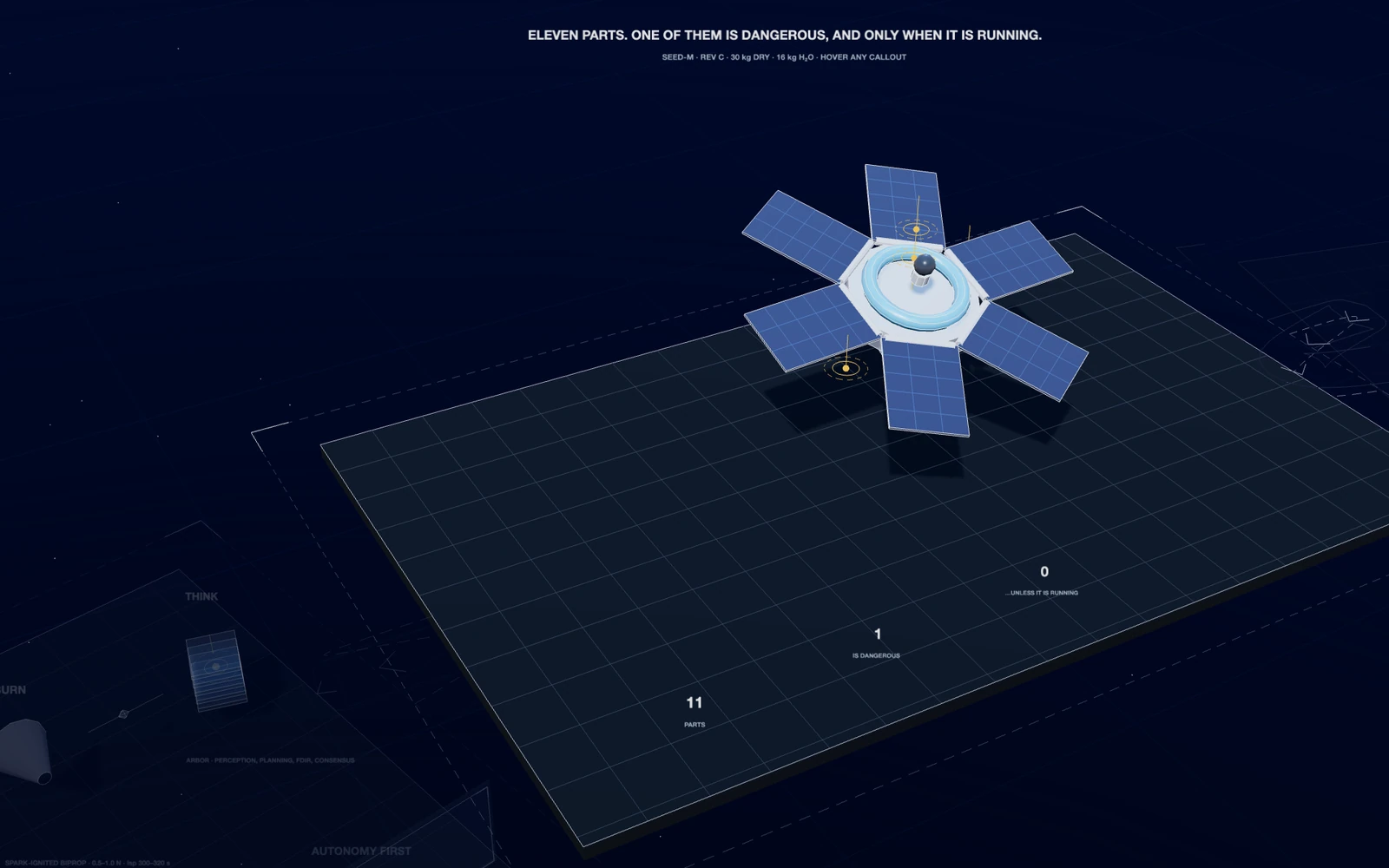 Plate 2 / 12
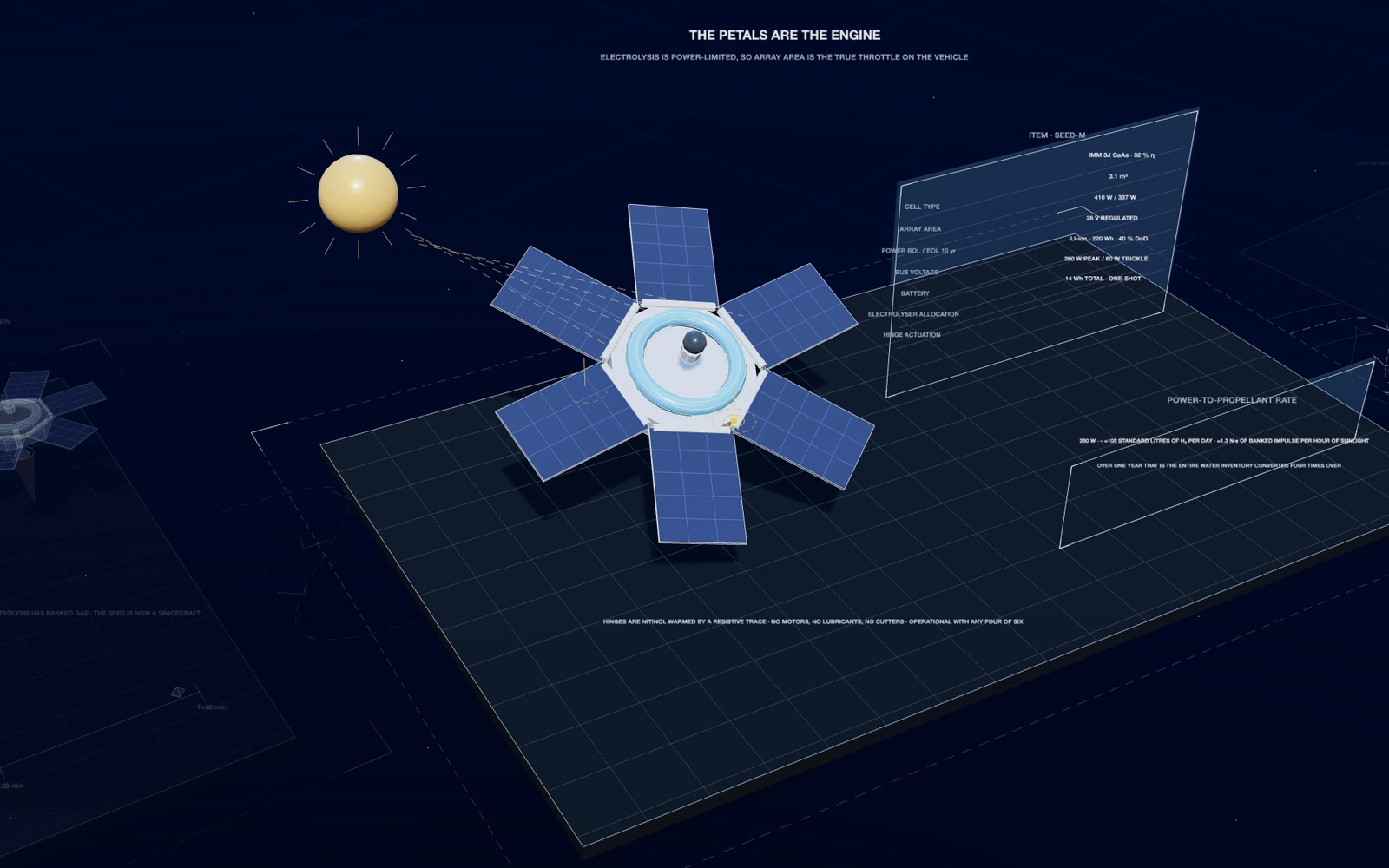 Plate 3 / 12
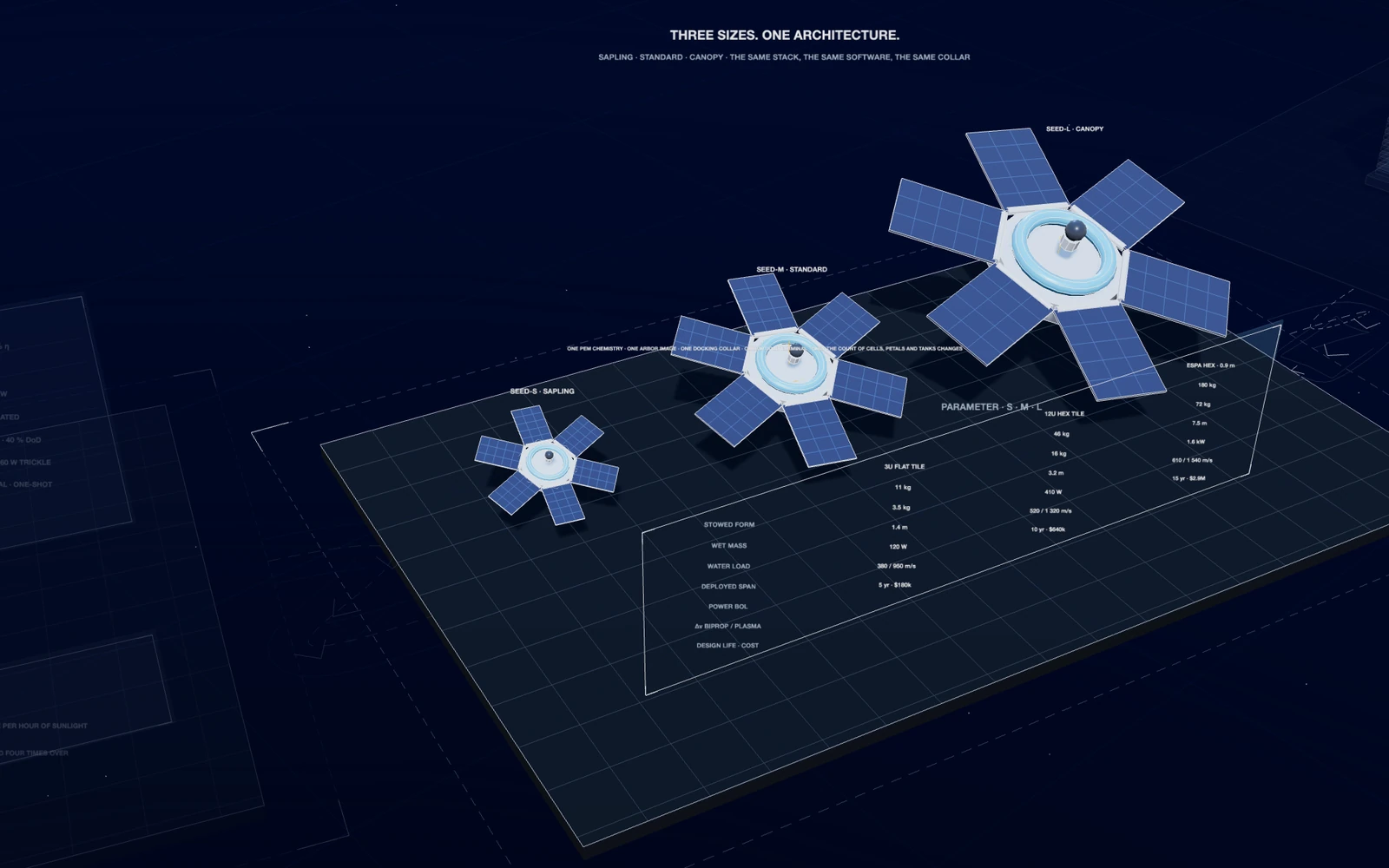 Plate 4 / 12
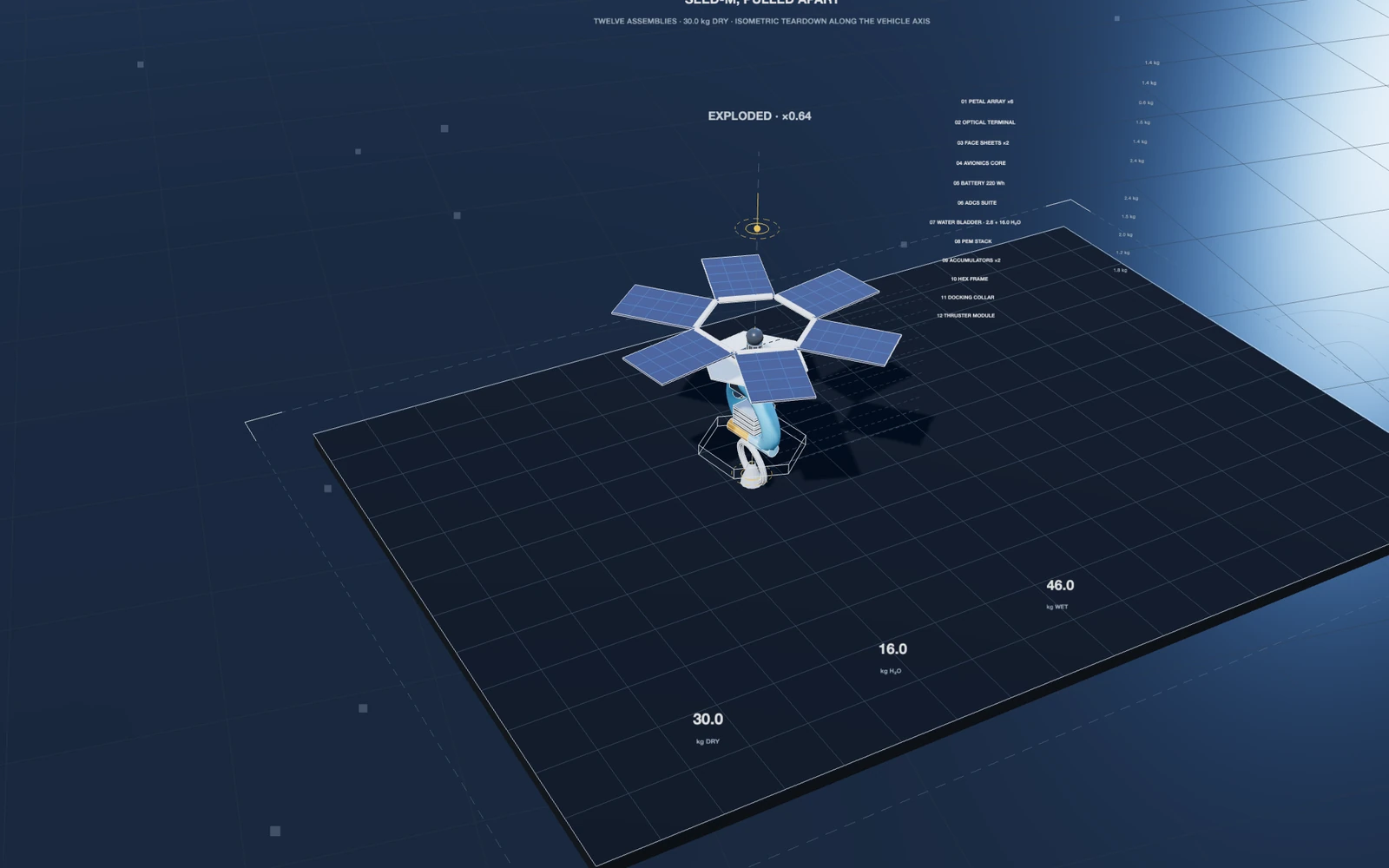 Plate 5 / 12
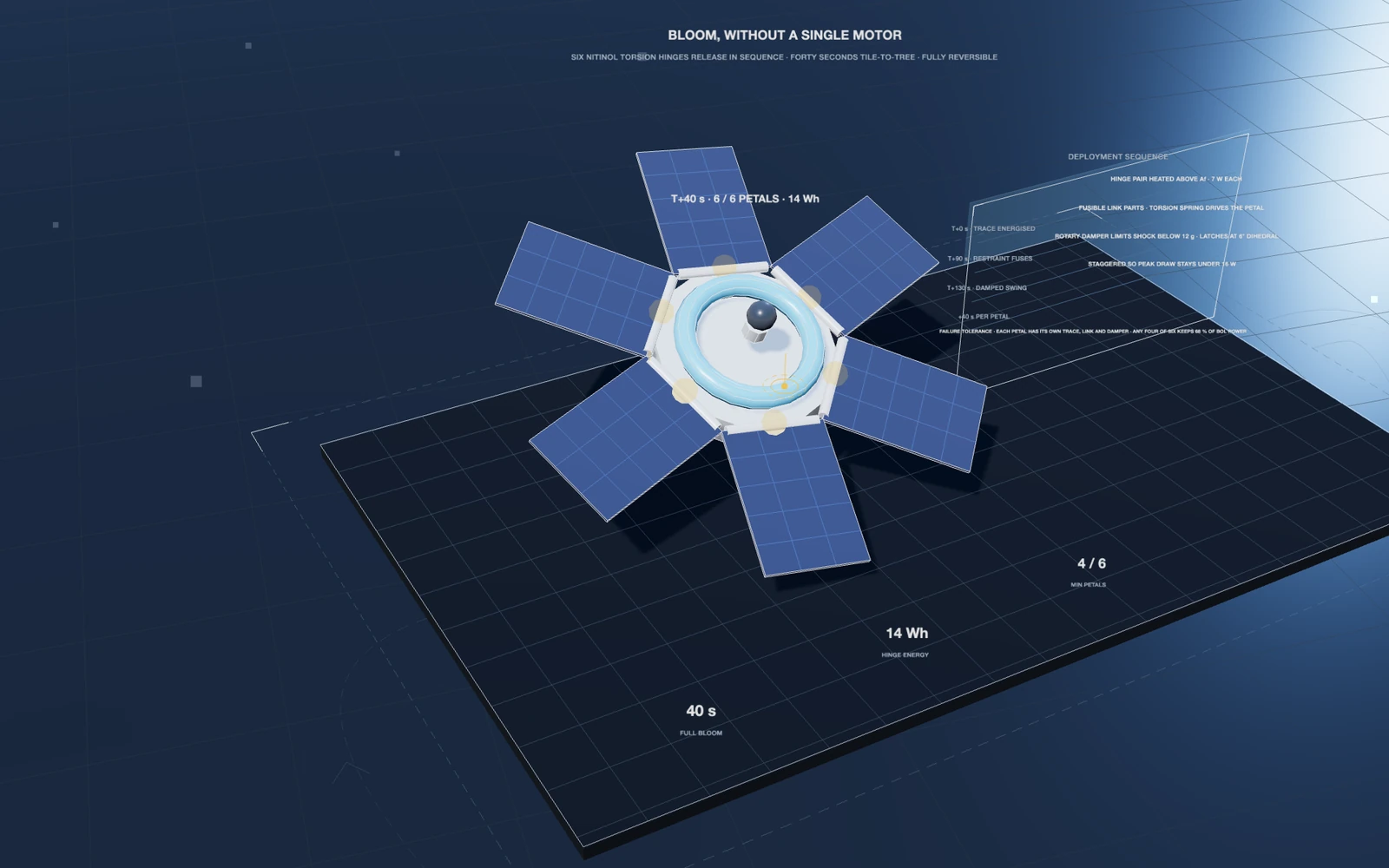 Plate 6 / 12
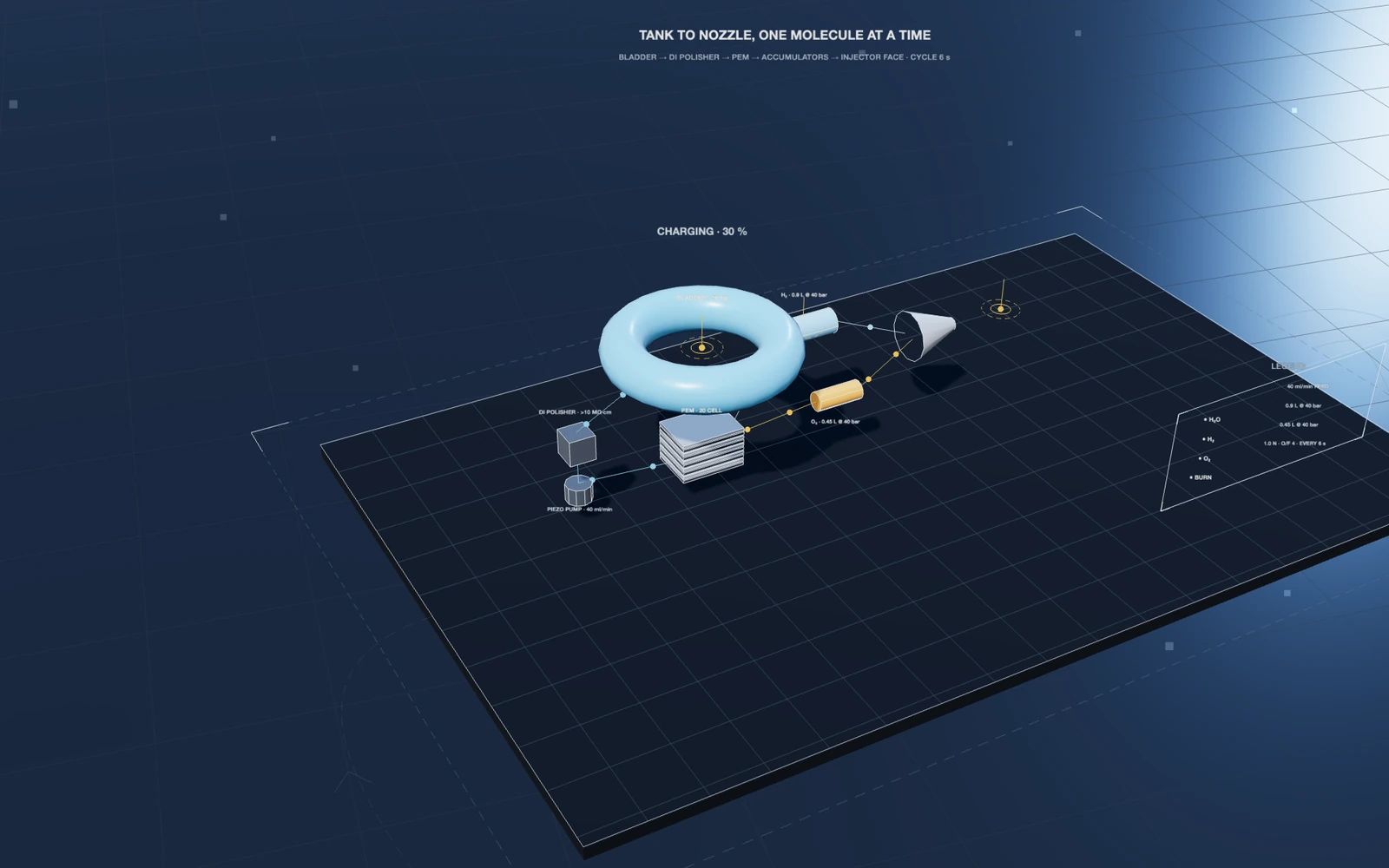 Plate 7 / 12
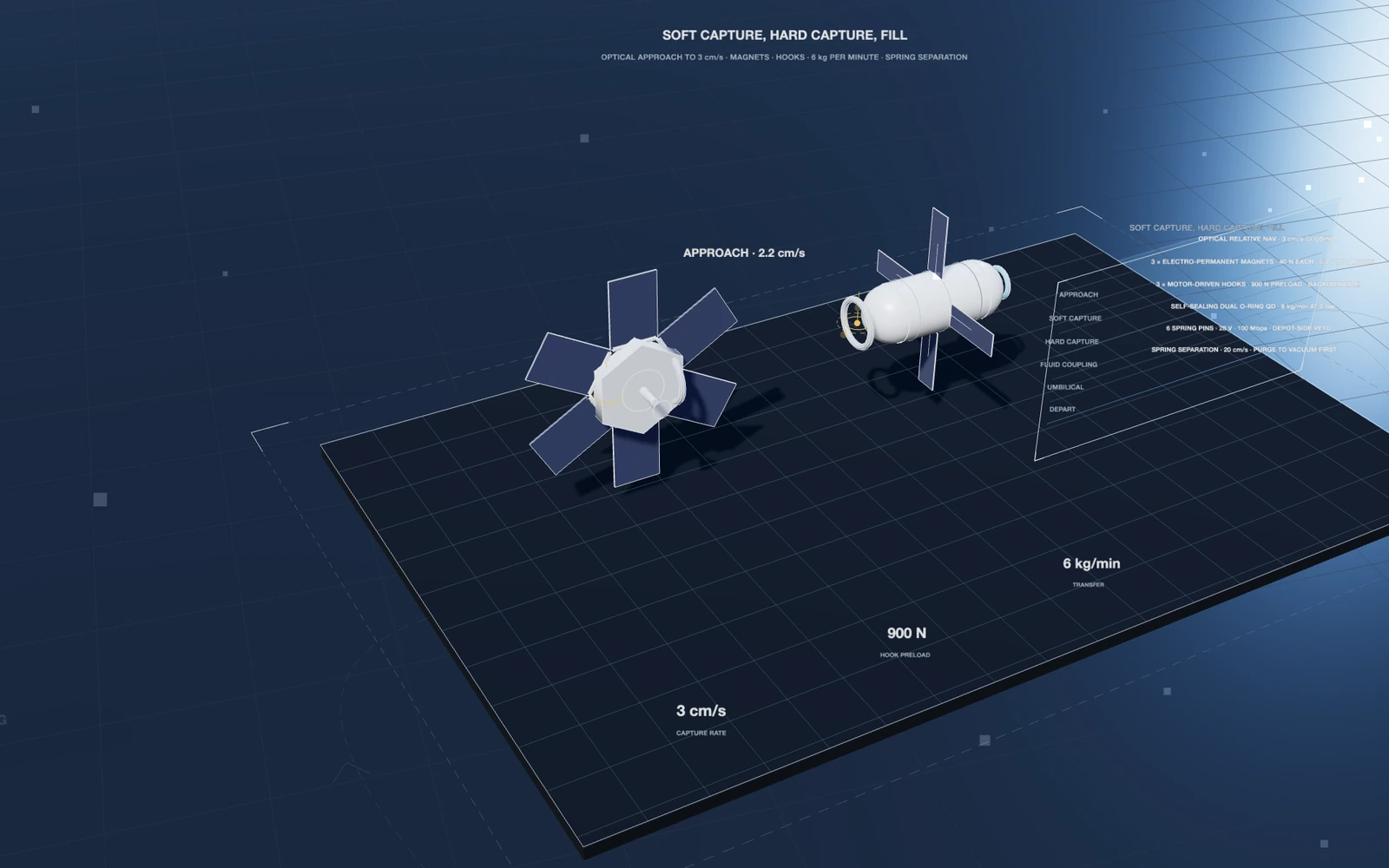 Plate 8 / 12
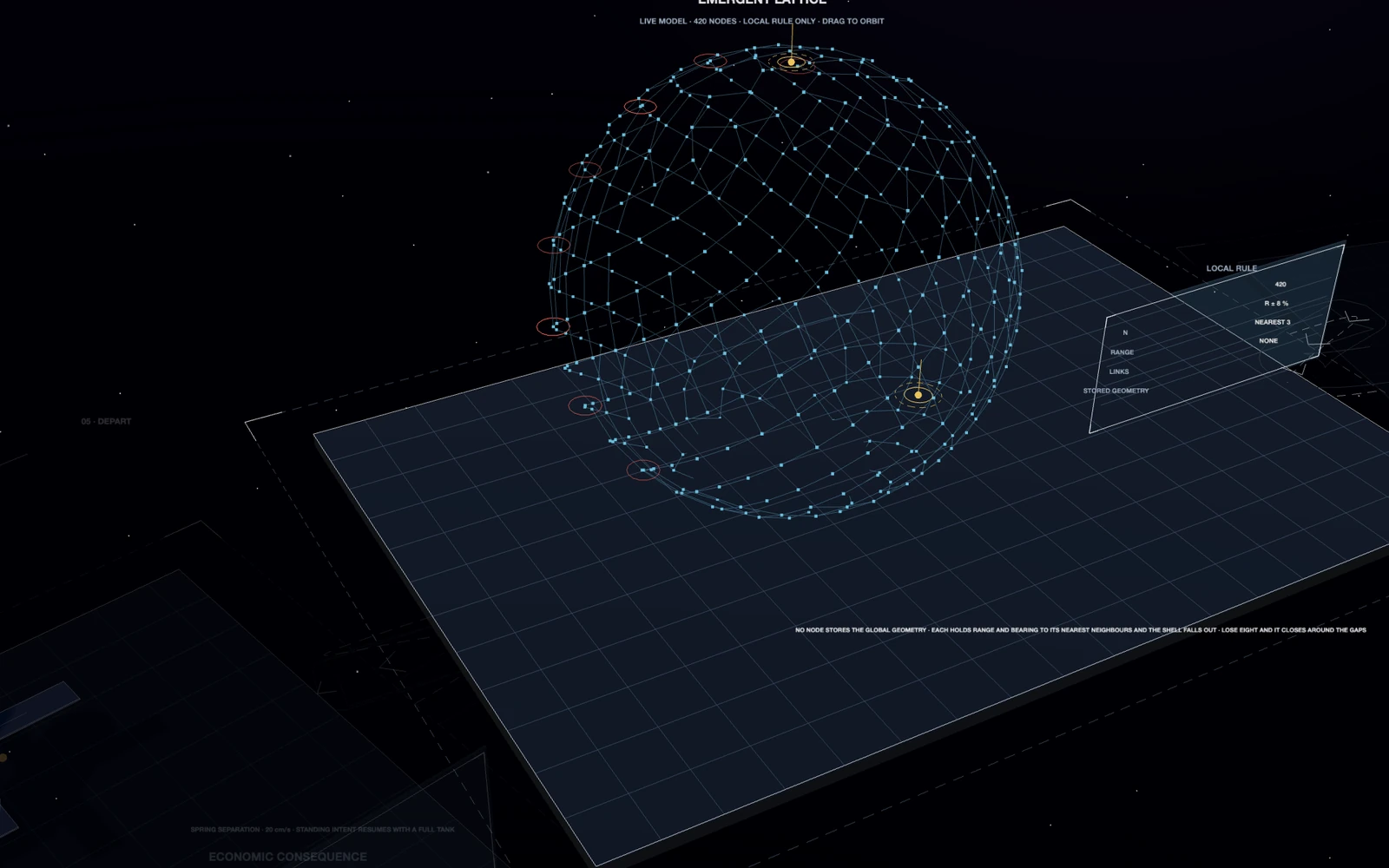 Plate 9 / 12
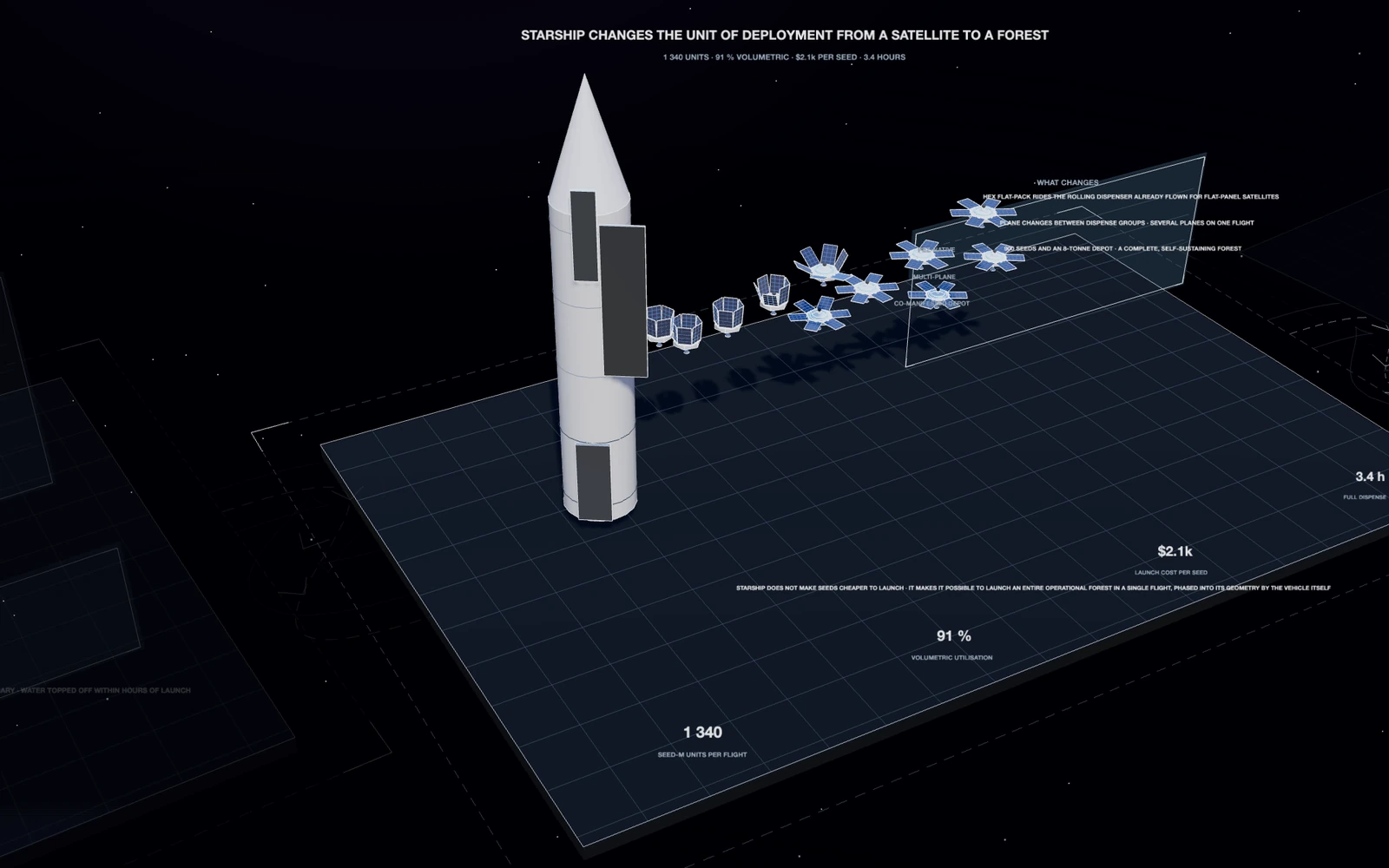 Plate 10 / 12
 Plate 11 / 12
 Plate 12 / 12
Film · KN-002 · sheet 024
Bloom, without a single motor.
The deployment sequence, captured from the live notebook drawing.
Reference assumptions · O-301
The design, in detail.
The concept’s dimensions, performance targets and cost assumptions, with their source notebook sheets.
| Mark | Item | Value | Note | Source |
|---|---|---|---|---|
| SEED-M · the vehicle | ||||
| V-01 | Mass | 46 kg wet | 30.0 kg dry and 16.0 kg of water; 3.6 kg of margin held through CDR | KN-002 · 022 · 023 |
| V-02 | Span | 3.2 m | Six petals, 3.1 m² at 87 g/m²; any four of six keeps 68% of BOL power | 011 · 024 |
| V-03 | Power | 410 W | Beginning of life; 337 W at ten years. IMM triple-junction GaAs at 32% | 011 |
| V-04 | Electrolysis | 20 cells | PFSA 50 µm, 1.9 V and 6.8 A a cell, 260 W peak, ~75% efficient, 40 bar out | 013 |
| V-05 | Accumulators | 0.9 + 0.45 L | H₂ and O₂ at 40 bar MEOP; 240 kJ stored, bounded by geometry | 015 |
| V-06 | Thrust | 1.0 N · 310 s | Bipropellant at O/F ≈ 4; 20 ms minimum bit; over 100,000 cycles | 014 |
| V-07 | Three modes | 150 · 310 · 800 s | Resistojet 30 mN · bipropellant 1,000 mN · microwave plasma 0.4 mN | 016 |
| V-08 | Δv per tank | 520 m/s | Onboard Δv is modest; lifetime Δv is unbounded with depots | 018 |
| V-09 | Bloom | 40 s | Nitinol torsion hinges, Af 65 °C; fusible Vectran tie, no pyrotechnics | 024 |
| V-10 | Autonomy | 99.2% | Anomalies resolved without ground; learned layers propose, L1–L2 refuse | 034 · 037 |
| The forest | ||||
| F-01 | Shell | 420 nodes | 550 km, one node per 220 km; local rule R ± 8%, nearest three links | 001 · 050 |
| F-02 | Optical mesh | 120 Mbps | 1550 nm to 2,400 km; 5 cm ranging; a 2 ns shared clock | 001 · 041 |
| F-03 | Tier 1 depot | 8 t | 170 SEED-M refills at 6 kg/min; 40 minutes dock to depart | 046 |
| F-04 | Starship | 1,340 tiles | One every 9 s, 3.4 h to empty, 91% volumetric; $2.1k launch per seed | 052 |
| F-05 | Falcon 9 | 190 units | Volume-limited (248 by mass); six columns of 32; 44 minutes to empty | 051 |
| The programme | ||||
| P-01 | Unit cost | $1.30M → $170k | Unit one to unit 1,000, ex-launch; 85% / 92% learning | 057 |
| P-02 | Delivered | $193k | A node on Starship; a forest of 420 delivered for $81M | 057 |
| P-03 | SEED-0 Sprout | $4.2M | Two SEED-M on a rideshare; 18 months from ATP | 059 |
| P-04 | SEED-1 Canopy | $38M | 24 SEED-M and a depot on a dedicated Falcon 9 | 059 |
| P-05 | SEED-2 Grove | $120M | Six SEED-L to NRHO, refuelled from a lunar-water demonstrator | 059 |
Source: notebook KN-002, technical concept review, rev 1.1. These are design assumptions and targets for the proposed programme; costs use the stated production volume and launch scenario.